

The Evolution of Workforce Management Solutions (WFM): Empowering Productivity
Workforce Management solutions is a comprehensive approach that is used by businesses to optimize their workforce’s productivity, efficiency, and performance. It involves various strategies, processes, and tools to ensure that the right people are in the right place at the right time, and equipped with the variety of tactics, necessary skills, and resources to accomplish organizational goals.
WFM encompasses tasks such as scheduling, forecasting, staffing, time and attendance tracking, and performance management. By effectively managing these aspects, organizations can streamline operations, reduce costs, enhance customer satisfaction, and ultimately drive success.
The Vital Role of Workforce Management
You already know what is workforce management system is, now it’s time to know why workforce management is so important for a company doesn’t matter the size of the business.
Workforce management includes all the procedures for staffing, predicting customer needs, scheduling, and adjusting to staffing demands. By ensuring the right people are in the right place at the right time, organizations can maximize efficiency while minimizing unnecessary expenses.
Additionally, effective workforce management fosters employee satisfaction and engagement by prioritizing fair scheduling and opportunities for growth, leading to lower turnover rates and higher morale within the workforce.
Key Components of Workforce Management
WFM solutions capabilities can range from the core functionality of time management, scheduling, and compliance to more advanced integration and predictive analytics. Here are some essential components of a Workforce management services:
i) Developing a solid strategy for workforce planning to ensure the right number of employees with the necessary skills are available to meet needs.
ii) Balancing employee preferences, labor laws, and business requirements when creating schedules.
iii) Tracking employee hours worked, breaks, and time off.
iv) Identify training needs and provide development opportunities to increase employee skills and performance.
v) Integrating with other systems such as payroll, timekeeping, and HRIS for seamless data exchange.
vi) Review and refine WFM processes regularly to adapt to changing organizational demand and market conditions.
Advantages of an Effective Workforce Management Solution
As I mentioned before, WFM systems are employed to automate and streamline these processes, allowing organizations to manage their workforce more efficiently. And make data-driven decisions to improve operational performance.
There are plenty of advantages to using workforce management services. Here are just a few:
Improve Productivity
Time Management and Schedule
Attendance Management
Enhanced Employee Satisfaction
Cost Savings
Payroll and Benefits
Risk Mitigation
Better Customer Service
Performance Monitoring
☞ Improve Productivity:
Workforce management solutions help optimize resource allocation by ensuring that the right employees with the appropriate skills are assigned to the right tasks at the right times. Not only that, It increases productivity as workloads are effectively managed and tasks are completed efficiently.
☞ Time Management and Schedule:
Monitoring employee hours is one of the most crucial components of workforce management. Establishing a scheduling system facilitates improved productivity and time management in addition to more efficient delegating.
☞ Attendance Management:
Attendance management is an important aspect of workforce management that involves tracking and managing employee attendance, absences, leaves, and other related data.
It begins with accurately tracking the time employees spend at work. Even, attendance management systems also track employee absences, including planned leaves and unplanned absences such as vacation, sick leave, or emergencies.
☞ Enhanced Employee Satisfaction:
Effective WFM tools can help to create a positive workplace by ensuring fair and accurate project allocations. Moreover, Workforce management practices such as fair scheduling, transparent communication, and opportunities for skill development contribute to higher levels of employee satisfaction. Employees feel valued when their preferences are taken into account, leading to increased morale and reduced turnover rates.
☞ Cost Savings:
By forecasting needs accurately, optimizing scheduling, and controlling labor costs, Workforce management can lead to significant cost savings for businesses.
This entails reducing overtime costs, limiting instances of overstaffing or understaffing, and enhancing overall cost predictability.
☞ Payroll and Benefits:
Most workforce management software can generate custom reports or something like features that provide information about payroll administration, employee benefits, and fiscal year data needed for legal services.
☞ Risk Mitigation:
Reducing risk and staying compliant are essential components for any organization, and are often time-consuming undertakings.
By ensuring compliance with labor laws and regulations, WFM helps companies mitigate the risk of legal issues, penalties, and lawsuits related to workforce management practices. Also, this protects the organization’s reputation.
☞ Better Customer Service:
WFM solution can raise the standard of customer service by making sure that there are enough staff members on hand to handle demand. As a result, Shorter wait times, quicker reaction times, and higher levels of customer satisfaction.
☞ Performance Monitoring:
This feature’s solutions assist you in monitoring and controlling worker performance, enable you to spot problem areas, and offer focused coaching and training. Some of the benefits of this feature are improved employee productivity, reduced turnover, increased workforce quality, etc.
Types of Workforce Management Software?
➊ Time and Attendance Tracking Software
➋ Scheduling Software
➌ Labor Forecasting and Demand Planning Software
➍ Performance Management Software
➎ Training and Development Software
➏ Payroll and Benefits Administration Software
➐ Employee Self-Service Portals
➑ Workforce Analytics and Reporting Software
➒ Communication and Collaboration Tools
➓ Workplace safety incident tracking software
➊➊ Customer relationship management tools
➊➋ Project management and communication tools
What is The Difference Between HR and WFM?
Human Resources encompasses the whole employee lifecycle, from recruitment to retirement, focusing on strategic talent management, organizational culture, and compliance with employment laws.
On the other hand, Workforce management is more operationally focused, concentrating on day-to-day activities. Such as scheduling, time and attendance tracking, and optimizing workforce productivity.
| Human Resources | Workforce Management |
|---|---|
| Encompasses long-term planning, hiring fresh talent, employee performance evaluation, and fostering a positive organizational culture. | Focuses on short-term goals such as daily scheduling, labor cost control, attendance management etc. |
| HR focuses on the strategic management of human capital to support organizational goals and objectives | Workforce management focuses on optimizing workforce productivity, efficiency, and performance. Its goal is to ensure that the right people are in the right place at the right time to meet organizational goals while minimizing costs and maximizing resource utilization. |
| While HR utilizes technology for tasks such as applicant tracking, performance management, and payroll processing. | WFM often relies heavily on technology-driven solutions such as scheduling software, time and attendance systems, and workforce analytics tools to optimize workforce efficiency and performance. |
| Takes an extensive approach that aligns with the long-term goals, core values, and mission of the company. | Often driven by operational requirements and real-time adjustment to ensure a smooth workflow. |
Important Factors in Choosing the Ideal Workforce Management Solution
Selecting the best workforce management solution for your organization is a vital decision that requires careful consideration of some important factors. Here are some key considerations to keep in mind:

Business Objectives and Needs: Understand your organization’s specific workforce management requirements, including personnel requirements, preferred scheduling, compliance regulations, and performance metrics.
Scalability and Flexibility: Choose a WFM solution that can scale with your organization as it grows and evolves.
Ease of Use: Consider the availability of training and support resources to facilitate smooth implementation and adoption across the organization.
Return on Investment (ROI): Calculate the potential possible ROI by projecting cost savings, increasing productivity, and reaping other benefits derived from implementing the solution.
Compliance and Regulations: Make sure that the workforce management system conforms to all applicable labor laws, industry rules, and data security specifications. This is especially important if your company works in highly regulated industries or regions.
Integration Capabilities: Assess the compatibility of the workforce management solution with your existing systems and software infrastructure, including the HR, payroll, time and attendance, and scheduling tools.
Analytics and Reporting: Consider the solutions that provide dashboards (customizable), real-time data visualization tools, and predictive analytics features to support informed decision-making and strategic planning.
The Future of Workforce Management
The future of workforce management is marked by several key trends and developments that are shaping the way organizations manage their employees. Here are some factors that will shape the future of workforce management:
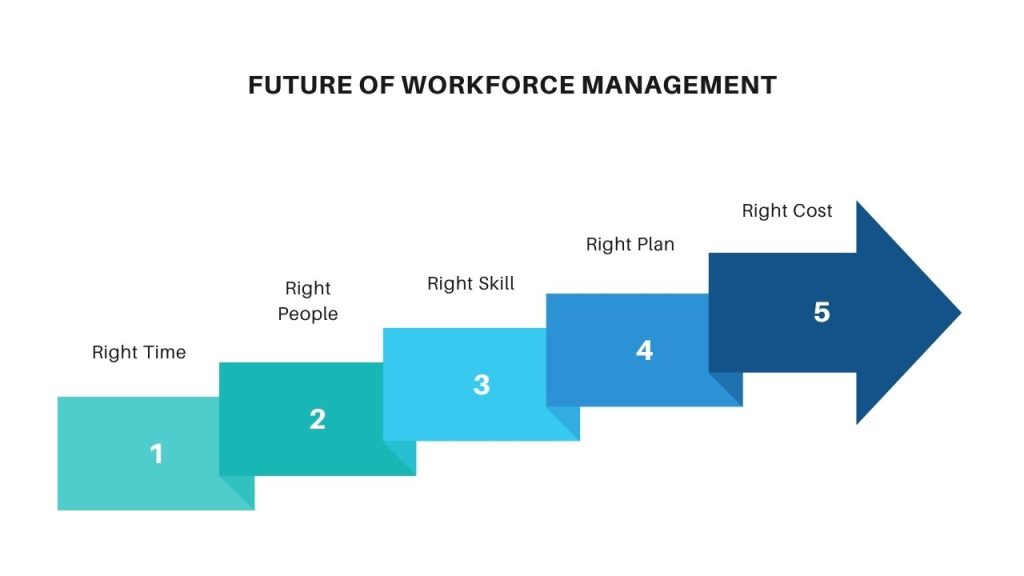
Remote Work and Flexible Work Arrangements:
The rise of remote work and flexible work arrangements is transforming workforce management practices. Businesses are adopting technologies and policies to support distributed teams, virtual collaboration, and remote productivity tracking.
Data-Driven Decision-Making:
Organizations are using analytics and workforce planning tools to make data-driven decisions regarding personnel and resource allocation, which is driving a shift in workforce management, even in the management of talent. Predictive analytics are predicting future labor needs and workforce trends.
Automation:
Automation and AI technologies are transforming workforce management by automating repetitive operations, improving data analysis, and improving decision-making processes. AI-powered technologies are utilized in recruitment, scheduling, performance management, and employee engagement.
Skills-Based Workforce Planning:
Traditional job roles are evolving, and skills-based workforce planning is becoming more prevalent. Businesses focus on identifying and developing essential skills within their workforce to adapt to changing business needs and technological advancements.
Innovating, being agile, making data-driven decisions, and focusing on enhancing the employee experience. And driving organizational success characterizes the future of workforce management in a rapidly evolving global landscape.
Related FAQs
WFM is a solution that helps companies streamline and automate the processes that manage time, organize an efficient labor force. It also ensure employee safety protocol, and make a productive, cost-effective workforce.
You should use workforce management to guarantee that your employees are where they need to be, at the correct time, and performing the necessary positions. It improves efficiency, saves money, keeps everyone happy, assists with long-term planning, and makes data-driven decisions. In essence, it ensures that your business runs smoothly and your personnel operates efficiently
Implementing Workforce management can benefit organizations of all sizes and industries. Not only that, It’s a perfect solution for anyone who is looking to fulfill their goals faster. Not only that, also prepare for the future, and improve employee happiness.
Contingent workforce management is the process of hiring and managing temporary employees. A contingent workforce comprises freelancers, independent contractors, and consultants who are not on the company’s payroll.
Final Verdict
Workforce management matters because it contributes to developing a framework that enables businesses to manage their operations through efficient scheduling, forecasting, and budgeting. Not only that, Organizations can plan and accomplish strategic goals while increasing efficiency by utilizing automation and other tools.
Finding and implementing the right WFM system for your industry results in a happy, responsive workforce that is performing as optimally as possible.

